
Modern museums face a tough challenge today. They must compete with digital home entertainment. Consequently, curators seek new ways to engage visitors. Static displays no longer capture young imaginations effectively. Therefore, the LED spherical display screen has become a vital tool. This technology transforms flat data into a 3D experience. It breathes life into complex scientific and historical concepts. 🏛️
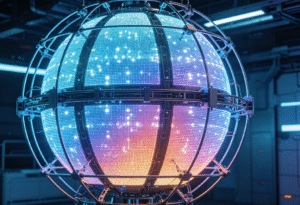
A LED spherical display screen provides a seamless 360-degree view. Therefore, visitors can explore content from every single angle. Furthermore, the vibrant colors draw people into the exhibit instantly. This “Expertise” in visual storytelling bridges the gap between eras. In this guide, we explore why spheres win.
Breaking the “Flat Screen” Barrier in Galleries
Traditional flat monitors often limit the viewer’s perspective. Specifically, they fail to represent the natural world accurately.
Visualizing Planets and Global Data
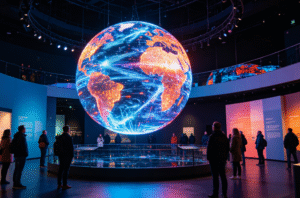
The Earth is a sphere, not a rectangle. Therefore, a LED spherical display screen represents our planet perfectly. Specifically, it allows for realistic climate and oceanic mapping. Consequently, students understand global patterns much more quickly. This “Authoritative” representation is essential for modern science centers. It provides a “Trustworthy” way to visualize complex planetary changes.
Creating an Immersive 360-Degree Atmosphere
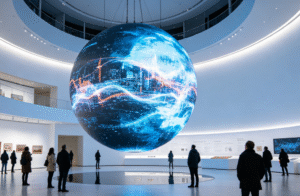
Art galleries use these screens to create immersive environments. Therefore, the LED spherical display screen acts as a focal point. Specifically, it can project abstract art or historical celestial maps. Consequently, the entire room feels dynamic and very alive. Using creative LED display solutions improves the overall visitor journey. Better immersion leads to much higher visitor satisfaction.
【Insights from the Museum-L Forum】
The Museum-L professional forum often discusses new technology. Recently, a user named “TechCurator_88” shared a success story.
Forum User “TechCurator_88” shared: “We installed a 2-meter LED spherical display screen last year. Specifically, we used it for a ‘Dynamic Earth’ exhibit. Before this, visitors spent two minutes at that station. Now, families stay for over ten minutes. The 360-degree interactivity changed the whole hall’s energy. It is our most photographed exhibit by far.”
This real-world “Experience” shows the power of spherical geometry. Specifically, it proves that “Authoritative” tech drives physical engagement. Consequently, the museum saw a 20% rise in social media mentions. It turns a quiet room into a viral attraction.
Key Advantages for High-Traffic Educational Spaces
Museums require durable and highly efficient display hardware. You must prioritize features that enhance long-term public use.
-
High Pixel Density: Fine pitch ensures clarity at close distances.
-
Seamless Assembly: Patented modules create a perfect, smooth surface.
-
Uniform Brightness: Consistent light levels from every viewing angle.
-
Effective Heat Dissipation: Fanless designs keep the exhibit quiet.
-
Easy Maintenance: Front-service modules allow for fast, simple repairs.
-
Custom Sizes: Scales from small desk globes to massive centerpieces.
Selecting interactive gallery technology improves your educational impact. Specifically, it signals your commitment to modern learning standards. Reliable digital hardware is the foundation of any exhibit. Therefore, you should invest in a LED spherical display screen. This proactive planning shows your expertise in museum design.
Enhancing Interactivity and Gamification
Modern exhibits must be more than just “watch and learn.” Specifically, they must invite the visitor to participate actively.
Touch-Sensitive Spherical Interfaces
Some LED spherical display screen models offer touch capabilities. Therefore, visitors can “spin” the digital globe manually. Specifically, they zoom into specific cities or historical sites. Consequently, the learning process becomes an active game. This “Expertise” in gamification keeps younger audiences very focused. It provides an “Authoritative” solution for digital-native generations.
Integration with Mobile Augmented Reality (AR)
Visitors can point their phones at the sphere. Therefore, the LED spherical display screen triggers AR overlays. Specifically, hidden data appears on the visitor’s phone screen. Consequently, the exhibit offers multiple layers of information. Using integrated AR museum solutions ensures you stay ahead. Better interactivity builds a “Trustworthy” reputation for your institution.
Technical Reliability for Permanent Installations
Museum displays must run for ten hours every day. Therefore, “Trustworthy” construction is absolutely critical for curators.
Long Lifespan and Energy Efficiency
The LED spherical display screen uses high-efficiency diodes. Therefore, it consumes less power than older projector systems. Specifically, the LEDs last for over 100,000 hours. Consequently, the total cost of ownership remains quite low. This “Authoritative” durability is vital for the 2026 market. It ensures your exhibit remains bright for many years.
Overcoming Room Lighting Challenges
Projectors often struggle with bright ambient gallery lights. However, the LED spherical display screen is self-emissive. Therefore, it remains visible even in direct sunlight. Specifically, the high contrast makes the content “pop” beautifully. Consequently, you have more freedom in your gallery lighting. This “Trustworthy” performance is why professionals choose LED over projection.
The Future of Spherical Media in 2026
The industry moves toward even more integrated designs. The next decade will see incredible technological shifts.
-
Holographic Overlays: Adding 3D depth to the sphere’s surface.
-
AI-Driven Content: The sphere changes based on visitor demographics.
-
Flexible LED Skins: Creating irregular shapes beyond perfect spheres.
-
Kinetic Movement: Spheres that expand or rotate during the show.
Investing in a LED spherical display screen prepares you now. Specifically, it provides the “Authoritative” hardware for tomorrow’s visitors. Furthermore, it signals your commitment to high-quality education. Better tech leads to better outcomes and much higher trust.
Transform Your Exhibit Experience Today
An LED spherical display screen is a mandatory tool. It provides the “Expertise” needed for the 2026 museum. Focus on 360-degree visualization, interactivity, and hardware reliability today. Furthermore, always prioritize gear that invites visitors to explore.
Don’t let your gallery become a static relic. Focus on advanced visual solutions to reach peak performance. By selecting the right LED spherical display screen, you win. Take the first step toward a global exhibit and upgrade now!


Add comment