
As digital visual scenarios evolve from two-dimensional to three-dimensional, the visual shortcomings of traditional flat LED displays continue to become apparent. Issues such as limited field of view, low space utilization, and homogenized visual experience make them unsuitable for the visual upgrade needs of commercial landmarks, educational venues, and outdoor landscapes. LED spherical screens, with their 360° panoramic display capabilities, have become the fastest-growing sub-category in the irregular-shaped display market. Continuous iterations of three core technologies—curved splicing, viewing angle compensation, and lightweight structure—enable this achievement.
Leading manufacturers, exemplified by SUPER VISUAL, have successfully transitioned spherical LED displays from bespoke, large-scale engineering projects to standardized, full-range products. While many industry professionals recognize the distinctive appearance of spherical displays, they often fail to distinguish the specific application boundaries of the three distinct types available; this article systematically deconstructs the underlying technical logic of LED spherical displays by examining their structural principles, parameter differences, and comparative advantages and disadvantages.
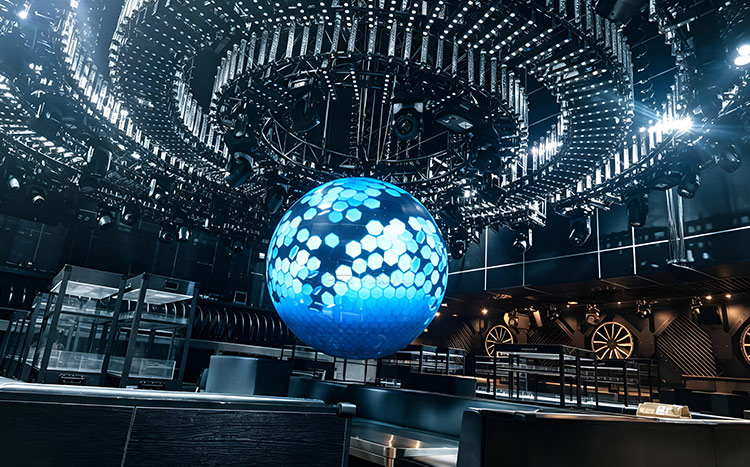
The Three Pillars of LED Sphere Architecture
From a product design standpoint, mass-produced LED sphere displays are divided into three major categories: Modular Cabinet, Pixel Dot Matrix, and LED Mesh/Grille. Their hardware frameworks, imaging logic, and application scenarios are entirely independent and mutually irreplaceable.
      [LED Sphere Displays]
       |
       +-------------------+-------------------+
       |                   |                   |
      [Modular Cabinet]   [Pixel Dot Matrix]    [LED Mesh/Grille]
      (High-Res/Indoor)  (Lightweight/Facade)   (Extreme Weather)
Modular Cabinet LED Spheres: The High-Definition Standard
Modular cabinet LED spheres represent the most mature and widely adopted technology in the industry. Manufacturers construct them by splicing standardized curved LED display modules onto a lightweight alloy internal skeleton. They precisely form rigid PCB boards to match the spherical curvature, while backend software seamlessly calibrates the displayed images.
-
Core Advantages: Exceptional image quality. This structure pushes the limits of resolution, achieving Fine Pixel Pitch (P1.25) for ultra-high-definition (UHD) indoor displays. Furthermore, it features a mature modular maintenance system where individual magnetic modules can be replaced hot-swapped without powering down the entire screen.
-
Best Application: Perfect for close-up viewing environments such as science and technology museums, planetariums, and high-end shopping mall atrium displays.
-
Limitations: Excessive dead weight. Due to the dense modules and internal framing, it is significantly heavier than the other two types, placing strict load-bearing demands on ceilings and walls.
Pixel Dot LED Spheres: The Lightweight Outdoor Solution
Pixel dot LED spheres break away from the traditional solid-board module design. Instead, thousands of independent SMD pixel dots form the display by mapping themselves across a 3D spherical coordinate system.
-
Core Advantages: Ultra-lightweight and translucent. A single pixel dot weighs only 5–15g, reducing the overall screen weight by 40% to 60%. This drastically cuts down on structural reinforcement and building modification costs. Additionally, the 10–50mm clearance gaps between dots allow natural light to pass through, eliminating the industry-wide issue of glare and daytime image washout.
-
Best Application: High-altitude installations, coastal sightseeing bridges, glass curtain walls, and scenic observation towers where structural reinforcement is impossible.
-
Limitations: Limited resolution. Due to physical spacing constraints, the minimum pitch is typically P4, resulting in pixelation if viewed closer than 5 meters.
Mesh/Grille LED Spheres: Engineered for Extreme Weather
Specifically developed for harsh outdoor climates, the core design of the LED mesh/grille sphere revolves around two critical pain points: wind resistance and heat dissipation.
-
Core Advantages: The hollowed-out grille structure increases natural air convection area by more than 3 times. Combined with internal silent thermal fans, the screen’s core temperature stays consistently below 45°C even under intense, direct sunlight, preventing rapid lamp decay. The open mesh design minimizes wind drag, giving the structure a wind resistance rating of up to Grade 15.
-
Best Application: Typhoon-prone coastal regions (like Hainan or Florida) and high-altitude, strong-wind environments.
-
Limitations: While highly translucent, it suffers from lower color saturation, making it unsuitable for high-contrast corporate branding graphics. It is best utilized for night-time architectural lighting, public welfare animations, and city landmarks.
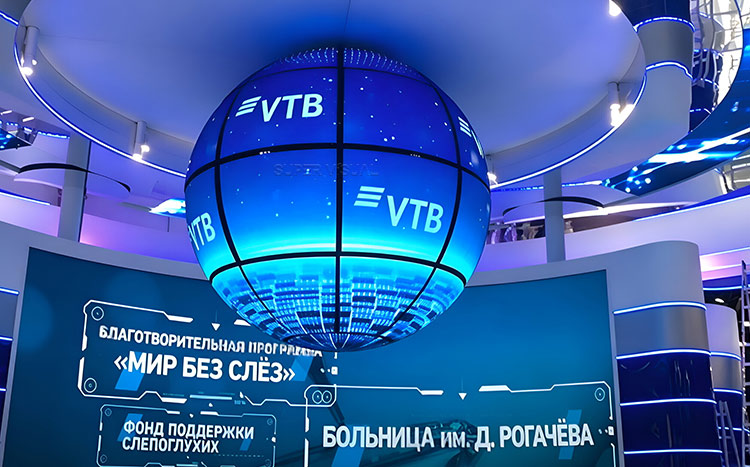
LED Sphere Technical Breakdown
To help procurement managers and integration engineers make informed decisions, here is a quick comparative matrix of the three core LED sphere display architectures:
| Technical Parameters | Modular Cabinet Sphere | Pixel Dot Sphere | Mesh / Grille Sphere |
| Optimal Environment | Indoor Close-up Viewing | Outdoor Glass Facades / High Altitude | Outdoor Extreme Climates / Coastal |
| Minimum Pixel Pitch | Up to P1.25 (Ultra-HD) | ≥ P4 (Medium Resolution) | ≥ P10 (Low Resolution) |
| Weight Profile | Heavy (Requires structural support) | Ultra-lightweight (Saves 40%-60% weight) | Medium-light (Low wind resistance) |
| Transparency Rate | 0% (Solid Surface) | 30% – 60% (High Transparency) | 40% – 70% (Maximum Airflow) |
| Primary Use Case | Edutainment, Science Museums | Commercial Facades, Glass Atriums | Architectural Lighting, City Landmarks |
Underlying Control Systems and Packaging Technologies
Beyond structural differences, these three types of spherical screens share a common foundation in underlying control software and LED encapsulation.
Viewing Angle Compensation Algorithm
Because the sphere curves outward, different zones of the screen sit at varying angles and distances relative to the viewer. Standard video mapping causes side-view dimming and color banding. To solve this, advanced backend software applies a viewing angle compensation algorithm, calibrating the brightness, grayscale, and color parameters pixel-by-pixel to guarantee a seamless, zero-distortion 360° visual profile.
SMD vs. GOB Encapsulation
The choice of LED packaging depends strictly on the physical environment:
-
SMD (Surface Mounted Device): Preferred for indoor, low-impact environments due to its cost efficiency and high color fidelity.
-
GOB (Glue on Board): For outdoor settings prone to dust, heavy rain, and physical contact, a GOB epoxy layer is applied over the board surface. This completely eliminates issues like dead pixels, dropped lamps, and glue aging.
Synchronous vs. Asynchronous Control
-
Synchronous Systems: Selected for live-streaming exhibitions, concerts, and real-time events to achieve millisecond-level signal synchronization.
-
Asynchronous Systems: Ideal for unattended commercial plazas and public parks. Content is stored locally on memory cards and played on a loop, lowering long-term labor and maintenance costs.
SUPER VISUAL’s Golden Selection Standard
A common mistake among project managers is a structural mismatch: blindly choosing a heavy, high-definition modular sphere for a high-altitude outdoor facade (leading to structural failures and overheating), or installing a low-resolution pixel dot sphere inside a close-up exhibition hall (resulting in a pixelated guest experience).
To eliminate these paint points, SUPER VISUAL has established an industry-standard Structural Layer Selection Model:
-
Indoor HD Education / Atriums → Choose Modular Cabinet Spheres
-
High-Altitude Facades / Glass Curtains → Choose Pixel Dot Spheres
-
Coastal / High-Wind Outdoor Landmarks → Choose Mesh/Grille Spheres
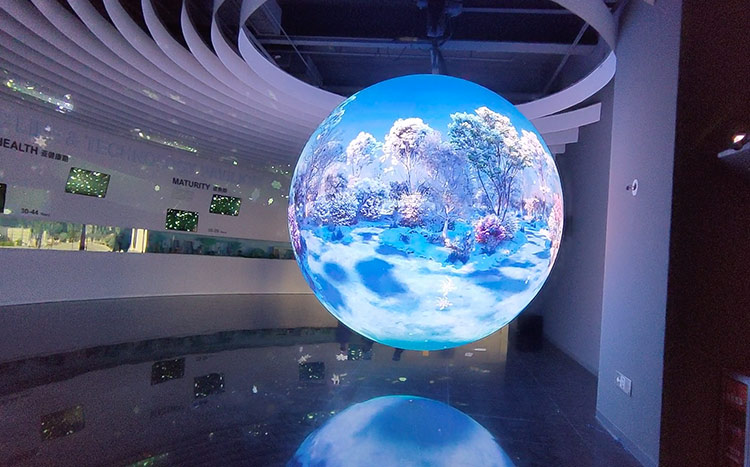
Shifting from Aesthetic Novelty to Structural Precision
There is a long-standing misconception that an LED sphere display is simply a flat screen bent into an arc. In reality, however, spherical displays are a complex, multi-disciplinary fusion of display physics, mechanical engineering, thermal dynamics, and 3D geometric algorithms. As a result, their technical barrier to entry is exponentially higher than that of standard curved screens.
As the creative LED market continues to move away from low-price, unstandardized assembly competition, manufacturers and project developers must select precise structural solutions according to specific application requirements. Meanwhile, the ongoing adoption of carbon-fiber skeletons and micro-dot LED packaging will make spherical displays even lighter while further reducing their power consumption. Therefore, B2B buyers and system integrators should evaluate each project by considering the installation environment, viewing distance, and climate conditions. Ultimately, this approach helps them avoid long-term maintenance risks and achieve a stable operational lifespan of 8 to 12 years.

Add comment